
History and Naming of Streets
To travel the streets of the Haynes Manor community is to engage with history. The neighborhood is unique because most streets are named for important African-American men and women.
How that happened seems lost in the past, but long-time Haynes Manor residents tell of inspiring figures honored and of a history that could be erased.
Built in the 1960s, Haynes Manor following nearby Haynes Heights, built in 1955, on a wave of optimism about black, middle-class housing. College administrators and faculty, public school principals and teachers, business owners, ministers and others made their homes in the area and promoted a culture of achievement, pride and continued striving.
Over half a century later Haynes Manor stays strong, but regularly faces challenges.
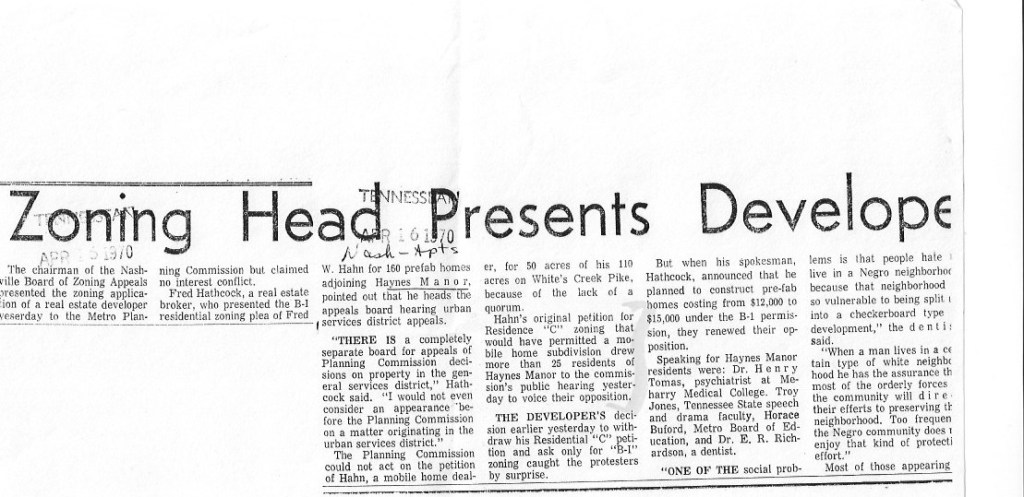
On April 16, 1970, The Tennessean reported that 25 Haynes Manor residents at a Metro Planning Commission meeting opposed a developer’s effort to build a mobile home park nearby. Speakers included a Meharry Medical College psychiatrist, a TSU faculty member, a member of the Metro Board of Education and a dentist.
The dentist said, “One of the social problems is that people hate to live in a Negro neighborhood because that neighborhood is so vulnerable …
“When a man lives in a certain type of white neighborhood he has the assurance that most of the orderly forces in the community will direct their effort to preserving that neighborhood. Too frequently the Negro community does not enjoy that kind of protective effort.”
HISTORIC NAMES OF STREETS
While the state and city work on museums to preserve history, Haynes Manor works to teach succeeding generations the history noted in the names of its streets.
DuBois, Baldwin and Revels Drives probably represent W.E.B DuBois, James Baldwin and Senator Hiram Revels of Mississippi, who in 1870, became the first African American elected to the U.S. Congress .
Others represented are:
Paul Lawrence Dunbar, poet
Faith Ringgold and Augusta Savage, sculptors
John Wesley Work III, composer, who directed the Fisk Jubilee Singers
Dr. Hubert B. Crouch, Sr., researcher, a founder of the National Institute of Science, and TSU’s first graduate school dean.
In addition, the community is named for William Haynes, an African-American minister and businessman who owned extensive land in the Haynes Trinity area. Neighborhoods, streets and a school are named in his honor.
The community’s challenge is to preserve a rich history while engaging the on-going task of preserving Haynes Manor.
by Karen F. Brown Dunlap
November 2018
 Haynes Trinity Neigborhood Coalition